The farmhouse at Semalle, near Alencon, where St. Therese lived for a year as a baby will be blessed and opened to pilgrims, May 20. 2017

Above is a video of the restored farmhouse in Semalle, a small commune near Alencon, where St. Therese lived with the family of her wet-nurse, Rose Taille, from March 1873, when she was three months old, until April 1874, when, at 15 months, she returned to her family in Alencon. 

The farmhouse is to be blessed and opened to pilgrims on May 20, 2017

On Saturday,. May 20, 2017, the house of St. Therese's wet-nurse, Rose Taille, will be inaugurated and opened to pilgrims.  The property of the diocese of Sees since 1956, the house had been in ruins.  Pilgrims often drove by it, but it was impossible to enter.  Fr. Jean-Marie Simar, rector of the Shrine at Alencon, reports that the gift of an enthusiastic benefactor made it possible for the diocese to fund the first stage of the restoration.  Some of the work was done by professionals.  M. Guy Fournier,a deacon of the diocese of Sees and director of volunteers for the Shrine of Sts. Louis and Zelie Martin at Alencon, reports that for nearly two yearsthe Shrine's volunteers have dedicated many hours to restoring the house. 

I thank Quest-France for much of the above information.  See their story, with photos of the inside and outside of the house.  See a photo of the stained-glass window in the church at Semalle depicting St. Therese; the artist included a cow in the background! 
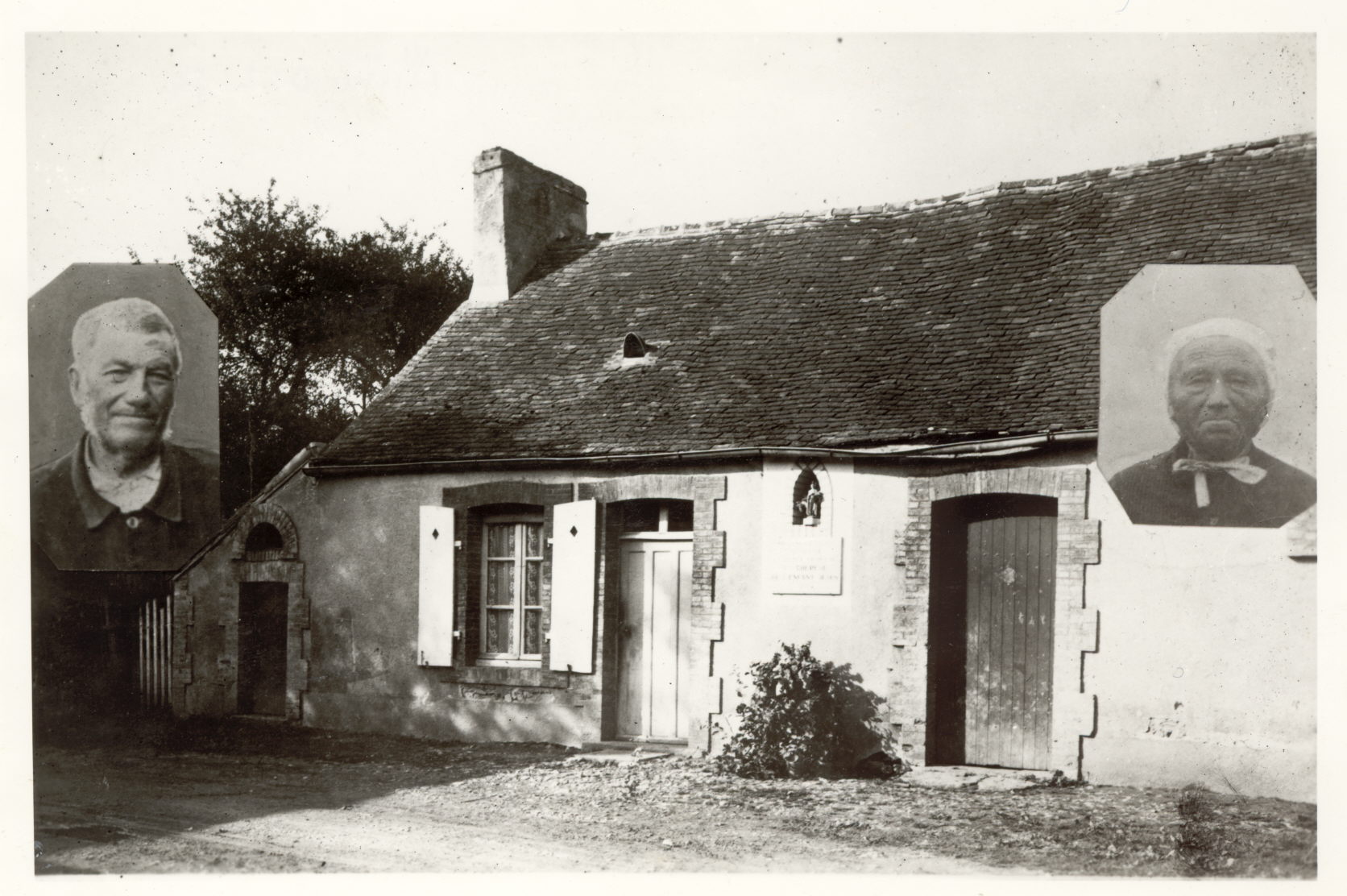
An early photo of the farmhouse at semalle where therese lived as a baby in 1873-1874.  at left, the farmer, moyse taille; at right, his wife, rose taille, known as "little Rose," Therese's wet-nurse.  PHOTO CREDIT: THE SHRINE OF STS. LOUI…

An early photo of the farmhouse at semalle where therese lived as a baby in 1873-1874.  at left, the farmer, moyse taille; at right, his wife, rose taille, known as "little Rose," Therese's wet-nurse.  PHOTO CREDIT: THE SHRINE OF STS. LOUIS AND ZELIE MARTIN AT ALENCON.

Rose Taille and the Martin family

Rose Taille, the wife of Moyse Taille, a countrywoman in whom Zelie and Louis had great confidence, saved Therese's life by serving as her wet-nurse when breastfeeding was the only way to save her life.  She took Therese to her own home where Therese lived among her children. Rose had earlier nursed the two little Josephs, the baby sons of Louis and Zelie, each of whom died before his first birthday.  Later, after Zelie's death, when Louis moved to Lisieux, his mother did not want to change towns, so he entrusted her to the care of Rose Taille. 

The program for inauguration day

The Shrine of Louis and Zelie Martin at Alencon announces the program of the inauguration on May 20:

  • Mgr Jacques Habert, bishop of Sees, will bless the house at 10:00 a.m.
  • Mass will be celebrated in the village church at 11:00 a.m., followed by a toast, a picnic lunch, and a walk to the house followed by a group visit

St. Therese's Poem, "The Divine Dew, or the Virginal Milk of Mary"

The little girl who had to leave home because she could not be breast-fed there grew up to associate this nourishment not only with the saving of her earthly life but with salvation itself.  See the image Therese kept of Mary nursing the child Jesus.  The title of Therese's first poem, "The Divine Dew, or the Virginal Milk of Mary," shows that the mystery of the child Jesus being breast-fed by his mother never ceased to fascinate her:  "Your divine blood is Virginal Milk!" Thanks to the Web site of the Archives of the Carmel of Lisieux.  For a fuller explanation of the doctrinal background of this daring poem, which unites the childhood of Jesus, Mary's nourishing him, the Incarnation, and the Eucharist, see the introduction to this poem in The Poetry of Saint Therese of Lisieux, tr. Donald Kinney, O.C.D. (Washington, D.C.: ICS Publications, 1996), pp. 35-37.  The introductions and notes, which greatly enrich our understanding of the poems, are not available online. 

A prayer of thanksgiving

Please congratulate the diocese of Sees, the shrine of Sts. Louis and Zelie, and all the generous persons who have made it possible for pilgrims to visit this sacred space.  Offer a prayer of thanksgiving for their faithful stewardship.  May God allow it to be not merely a visit to an historic house but a place to be drawn more deeply into the mystery of how Jesus nourishes us with the Eucharist as Mary nourished Him with her virginal milk.

May 1, 2017: Celebrating the feast of St. Joseph the Worker with Sts. Louis and Zelie Martin

An icon of St. Joseph the Worker with the Christ Child by Lewis Williams, OFS.  Available from Trinity Stores.  For ordering information, please click on the image.  Your purchase supports this Web site.

An icon of St. Joseph the Worker with the Christ Child by Lewis Williams, OFS.  Available from Trinity Stores.  For ordering information, please click on the image.  Your purchase supports this Web site.

     Although the feast of St. Joseph the Worker was established by Pope Pius XII in 1955, long  after Louis and Zelie Martin died, it has significance for these married saints.  Both of them were hard workers, who had gotten trained in skilled crafts (for Louis, making watches and clocks; for Zelie, manufacturing point d' Alencon lace).  They earned a place for themselves in the new class of artisans, and they employed workers in their businesses and domestic servants in their homes.  Although in their lifetimes, and solely by the work of their hands, they earned a great deal of money (enough to buy three castles in France, as their vice-postulator, Father Sangalli, told me)[i], they identified closely with those who worked for them.  A careful analysis of their lifestyle shows that they lived far below their means.  As their income increased, instead of yielding to lavish spending, they saved and invested their money, lent money to those in trouble, and gave generously to the poor, to charities, and to the Church.

     In Alencon Louis and Zelie got up early every morning to attend the 5:30 a.m. Mass, first at St. Pierre de Monsort, the parish church of the working-class neighborhood where they lived from their marriage in 1858 until they moved in 1871, and later at Notre Dame.  The neighbors, hearing their door close, would say "Oh, it's only that holy Martin couple going to Mass. We can turn over and sleep some more."[ii]  Later, when Louis was a widower, his daughters sometimes persuaded him, out of concern for his health, to wait for the seven o'clock Mass. But, when alone, he always chose the first Mass at 6:00 a.m.  When they asked why, he answered "Because it is the Mass of the poor and the working people."  (Workers had to be on duty so early that they could attend only the Mass at dawn).  For the same reason, Louis always traveled third class.[iii]  Although he had no choice but to recognize the rigid class distinctions then operating in French society, Louis did what he could to cross the barriers.

     Louis Martin was a careful and exact businessman, and he was known for paying his workers and all his debts promptly.  His motto was “always cash: no credit.”  “He considered it a crime against society to delay in paying, to the detriment of the workers and tradespeople, whose credit is limited, and that such practices led to ruin.”[iv]  He used to recount the story of a dressmaker, a poor widow with four children, the youngest only two, whose whole family depended on her daily wages.  The wealthy women who employed her refused to pay their bills promptly.  When she knocked at their doors and begged for the money they owed, they refused to pay.  Because of their refusal,she eventually died of tuberculosis.  Louis’s voice used to tremble with anger when he told this story.[v]

     Zelie was known as a very good employer.  At least one lacemaker worked for Zelie for 15 years, and she employed the same dressmaker for 18 years.  These women made lace for Zelie in their homes, bringing it to her every Thursday to receive payment and to pick up the lace designs for the next week.  She visited them after Vespers on Sunday and, when they were sick, made sure they lacked nothing. 

     Zelie was also known as a good mistress to her domestic servants.  On March 2, 1868 Zelie wrote to her sister-in-law, Celine Guerin:

 It’s not always high wages that assure the loyalty of household help; they need to feel that we love them. We must be friendly towards them and not too formal. When people are good-hearted, one is sure they’ll serve with affection and devotion. You know that I can be very sharp; however, all the household help I’ve ever had loved me, and I’ve kept them as long as I wanted.
The one I have at the moment would be sick if she had to go away. I’m sure if she were offered 200 francs more she still wouldn’t want to leave. It’s true that I don’t treat my servants any differently than my children.[vi]

When Zelie went out socially, she was uncomfortable at being waited on and unhappy about the distinctions made between different classes of people, looking forward to heaven where “the last will be first.”  Commenting on an entertainment where the wealthy were invited by letter to the best seats and the poor received only cards for back seats (separated by a barrier from the seats of the wealthy!), Zelie wrote “It’s no use; only in heaven will the poor be able to have the best of everything.”[vii] 

            Zelie and Louis were both very devoted to St. Joseph.  One of Louis’s baptismal names was Joseph, and they named both of the two baby sons they lost “Joseph.”  Zelie had a statue of St. Joseph before which she loved to pray.  As Joseph is the patron of a happy death, she often prayed to him for those she knew who were dying, especially asking him to allow those who had not practiced the faith to return to the Church before they died. 

            On this feast of St. Joseph the Worker, let the Martins inspire us to imitate their diligence at work; their concern for workers and for the unemployed; and their simple living.  .  St. Joseph the Worker, pray for us!  Sts. Louis and Zelie Martin, pray for us!

Notes and further reading: 

[i] Personal interview in Lisieux, October 20, 2008.

[ii] The Father of the Little Flower, by Celine Martin (Sister Genevieve of the Holy Face).  Rockford, Illinois: Tan Books and Publishers, 2005, pp. 4-5.

[iii] Ibid. p. 19,

[iv] Story of a Family, by Stephane-Joseph Piat.  New York; P. J. Kenedy & Sons, 1947, p. 69. 

[v] Ibid., p. 69-70.

[vi] A Call to a Deeper Love: The Family Correspondence of the Parents of Saint Therese of Lisieux, 1863-1885..  Staten Island, New York: Alba House/Society of St. Paul, 2011, pp. 33-34. 

[vii] Ibid., p. 305.

Purchases support this Web site.  Thank you!


A radio interview with Maureen O'Riordan about Saints Louis and Zelie Martin on January 19, 2017

On Thursday, January 19, 2017, Magnificat Ministries will broadcast my interview with them about Saints Louis and Zelie Martin on their Internet radio show "Your MorningTradition."  You have a choice of four times to hear it: 6:00 a.m., 7:00 a.m., 3:00 p.m., and 4:00 p.m. Central Time.  To listen, visit www.magnificatmedia.com at one of those times and click 'Radio' and then 'Live Radio Broadcast.'  I talked with Mike and Lisa Austin, the show's hosts, about Saints Louis and Zelie: their personalities, their marriage, their family.  One of my readers in Great Britain who wants to make Louis and Zelie better known recommended me for this opportunity.  I'm most grateful to her and to Mike and Lisa.

"Death of a mama," on the anniversary of the death of St. Zelie Martin on August 28, 1877

The death of a mama - August 28th, 1877

photo courtesy of the Archives of the Carmel of Lisieux.

appeared in  Thérèse de Lisieux – n ° 829 – January 2003.  Our thanks to the Shrine at Lisieux for permission to translate it and publish it in English

translated by Maureen O’Riordan for "Saints Louis and Zelie Martin, The Parents of St. Therese of Lisieux"  

In the evening of August 26th, 1877, Louis Martin went to the Church of Our Lady to find the priest, and he himself wanted to escort the Blessed Sacrament. The whole family was assembled around the deathbed. Their hearts blended in one and the same prayer. Thérèse recorded this souvenir: "The touching ceremony of the last anointing is also deeply impressed on my mind. I can still see the spot where I was by Céline’s side. All five of us were lined up according to age, and Papa was there, too, sobbing.”1

The Sacrament was administered, and the patient’s sufferings quieted down a little. Madame Martin fell into a kind of coma. She was as though destroyed, her arms and legs swollen, unable to move her body, unable to make herself heard. It was necessary to try to interpret her thoughts by the imperceptible movement of her lips. But her eyes still spoke. When, the next day, summoned by a letter from her daughter Marie, Monsieur and Madame Guérin (Madame Martin’s brother and sister-in-law) entered her bedroom, she welcomed them with a smile, then fixed on her sister-in-law, for a long time, a deep and pleading look, as if she wanted to tell her all the hope that she put in her and her infinite gratitude.

After she had a hemorrhage, it was at the very beginning of Tuesday, August 28, 1877, at exactly thirty minutes after midnight, after a very short agony, that Madame Martin died gently. Her husband and her brother, summoned by the nursing sister, rushed into the room in time to receive her last sigh.

They immediately told the older girls, who, reassured by the nursing nun, had left the dying woman at nine o’clock in the evening. Pauline, who had taken refuge in a little room in the garden above the laundry, went in tears to the two little girls (Céline and Thérèse), but she did not want to disturb their sleep. She delayed giving them the harrowing news until the next morning.

M. Martin led Thérèse to the funeral bed. She recounts this scene herself: “Papa took me in his arms and said, ‘Come, kiss your poor little Mother for the last time.’ Without a word I placed my lips on the forehead of my dear mother.”

She seemed to sleep. Although she had reached almost the end of her forty-sixth year, she looked much younger. The face, emaciated and sculpted by suffering, had taken on, in death, a moving expression of majesty and youth. A moving atmosphere of recollection and supernatural calm enveloped the temporary mortuary. M. Martin and his daughters did not grow tired of contemplating the physiognomy of the one who, having worked so hard, at last knew rest.

As for the youngest, she gives us, in her autobiography, her testimony about these dark days. She was then four and a half years old:

I don’t recall having cried very much, neither did I speak to anyone about the feelings I experienced. . . . . I looked and listened in silence. No one had any time to pay any attention to me, and I saw many things they would have hidden from me . . . For instance, once I was standing before the lid of the coffin . . . which had been placed upright in the hall. I stopped for a long time gazing at it. Though I'd never seen one before, I understood what it was. . . . I was so little that in spite of Mama's small stature, I had to raise my head to take in its full height. It appeared large. . . . and dismal. . . . .3

The funeral in Alençon

The funeral, according to the custom of that time, took place the day after Zélie’s death, that is to say on Wednesday, August 29th, at nine o'clock, in the parish church where relatives and friends were convened. As was the custom at that time, the daughters of the deceased woman did not attend the ceremony. She was buried in the cemetery of Our Lady’s Church in Alencon.

saint Zelie Martin's first tombstone.  it marked her grave in the  cemetery of the church of notre dame in alencon until 1894, when her  body was moved to lisieux and interred beside the body of her husband.    photo credit:  sus…

saint Zelie Martin's first tombstone.  it marked her grave in the cemetery of the church of notre dame in alencon until 1894, when her body was moved to lisieux and interred beside the body of her husband.   photo credit:  susan ehlert.

It was only in October, 1894, after M. Martin’s death, that M. Guérin, wishing to join in the tomb those whose common life had been a model of conjugal union, transferred the body of his sister to the family vault at Lisieux. The granite tombstone with the funeral inscription that had marked Mme. Martin’s grave at Alencon was then deposited in some free space nearby. Fifty-one years later it was recovered intact and was installed in a good location in the garden of the Pavilion (a small piece of garden with a hexagonal tower owned by the Martin family).

Praises for the memory of Madame Martin were not lacking. Without beating around the bush, the parish priest of Monsort declared that “there was one more saint in heaven.”

Mme. Guérin, who had also received her sister-in-law’s confidence and had many times profited by her experience and her delicate services, will recall her distinguished merits in a letter addressed, fourteen years later, in 1891, to her niece, who has become a Carmelite, Thérèse of the Child Jesus:

"What have I done, then, that God has surrounded me with such loving hearts! I did nothing but answer the last look of a mother whom I loved very much, very much. I believed I understood that look which nothing will be able to make me forget. It is engraved within my heart. Since that day, I have tried to replace her whom God had taken away from you, but, alas! nothing can replace a Mother! However, God has willed to bless my feeble efforts, and today He permits me to receive the affection of these young hearts. He willed that the mother who guided your early childhood be raised to a more sublime glory and enjoy heavenly delights. Ah! it is because, little Thérèse, your parents are among those we may call saints and who merit bringing forth saints.”4

The evaluation of Louise Marais, who lived for twelve years with the Martin family, is no less touching. Mme. Martin, during her illness, was forced to discharge this faithful maidservant, who was a bad influence on Léonie. Louise asked, as a favor, to continue to work for the family until the death of Mme. Martin, claiming that no one could nurse her as well as she could. Indeed, until the end she surrounded the sick woman with the most complete devotion. She moved away then, for the re-education of Léonie demanded it, but she took with her the indelible memory of the one who had shown her so much sweetness. In 1923, some months before dying, she wrote to the Carmel of Lisieux:

In my sharp suffering, I invoke my little Thérèse and, at the same time, her good and holy mother, because, if little Thérèse is a Saint, her mother, in my opinion, is also a saint and a great saint. She was very much tried during her life, and she accepted it all with resignation. And then, how she could sacrifice herself! For herself, anything was good enough, but for others, nothing was good enough. I could say a great deal to you if I told of all her goodness and her submissiveness to the will of the good God.”5

Louder than all these testimonies rises the voice of M. Martin, who never spoke of his wife without attributing to her the qualifier of “saintly;” the voice of the daughters, who, under the oath of faith, affirmed her maternal virtues in their depositions at the Process of Beatification of their little sister. Louder still speaks the youngest. Could there ever be a more beautiful portrait of a mother than this stanza written by Thérèse? 

I loved Mama’s smile.
Her deep gaze seemed to say:
“Eternity overwhelms me and attracts me.
I’m going to go up in the blue Sky
To see God!”6

2 1 Story of a Soul, Ms. A, 12v.

2 Story of a Soul, Ms. A, 12v. 

3 Story of a Soul, Ms. A, 12v

4 Letters of St. Thérèse of Lisieux, Volume II, 1890-1897, tr. John Clarke, O.C.D. (Washington, D.C.: ICS Publications, 1988), pp. 745-46. Note that the last sentence of the quoted passage is inauthentic. 

5 quoted in Story of a Family: The Home of the Little Flower, by Stephane-Joseph Piat, O.F.M., tr. by a Benedictine of Stanbrook.  New York: P. J. Kenedy & Sons, 1947., p. 260.  Note that I translated this article, "Death of a mama," from an article that appeared in Therese de Lisieux, no. 829, in January 2003.  It was only in 2016, searching for the source of this quotation from Louise Marais, that I realized that most of the text of this article is drawn from Story of a Family, so I want to acknowledge that book here.  Note that the maidservant Louise Marais was not only a bad influence on Leonie; she beat her and alienated her from her mother. Later Leonie said “I forgive my tormentor, and I am grateful to her for looking after my mother so well during her last illness.”

6 The Poetry of Saint Thérèse of Lisieux, tr. Donald Kinney, O.C.D. (Washington, D.C.: ICS Publications, 1996), PN 18, p. 96). 

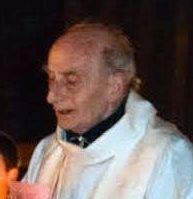
Father Jacques Hamel's letter about Saints Louis and Zelie Martin: "Do not be afraid of holiness!"

"Feast of All Saints

November 1, 2015

Many are the saints we celebrate on November 1st. We know some of them by name. They are celebrated in the liturgical calendar.  But in this "great crowd", many are anonymous. They were considered lost, but they are alive, close to God, participating in the fullness of his love. They believed and loved at the heart of their lives. That is why they are close to God.

Holiness is also our vocation. The baptism we have received has made us the son and the daughters of God. Do not think that holiness is not for us. If we think that, it is because we are creating a false idea of holiness.  It is not to do extraordinary things, to accomplish wonders. It is enough to love in the reaity of our lives, whatever the cost.

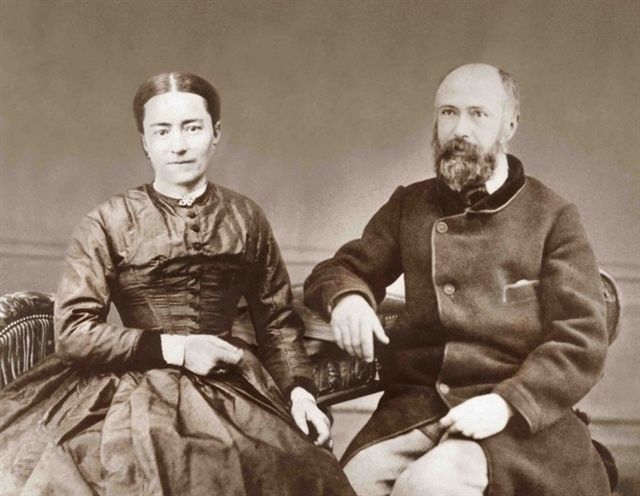
Louis and Zélie Martin, who were recognized as saints on Sunday, October 18th, are for us an example and a support. Their life was simple, like the lives of many of our families. But their whole existence was oriented toward the Kingdom of Heaven. Their only desire was that "God be served first.”  They experienced painful circumstances, but they kept on course by a faith nourished by the sacraments and by prayer, service of the poor and surrender to God, who never stops supporting us.

Baptized, we are the sons and daughters of God. It is by living this filial relationship, day after day, that we become saints. Holiness is a gift of God. It is he who makes us saints. Do not be afraid of holiness!
Happy feast to each.

Pére Jacques'

Translated with thanks from the parish newsletter of the church of Saint Etienne.  Read the letter of Fr. Jacques Hamel in its original French.

Photo of Fr. Jacques Hamel courtesy of the Diocese of Rouen.  Photo of Saints Louis and Zelie courtesy of the Shrine at Alencon.