

St. Louis Martin's Death Record and the Story of His Death: July 29, 2026
/Louis Martin’s Death Record: A Document of His Final Hours
The original civil registration of Louis Martin’s death
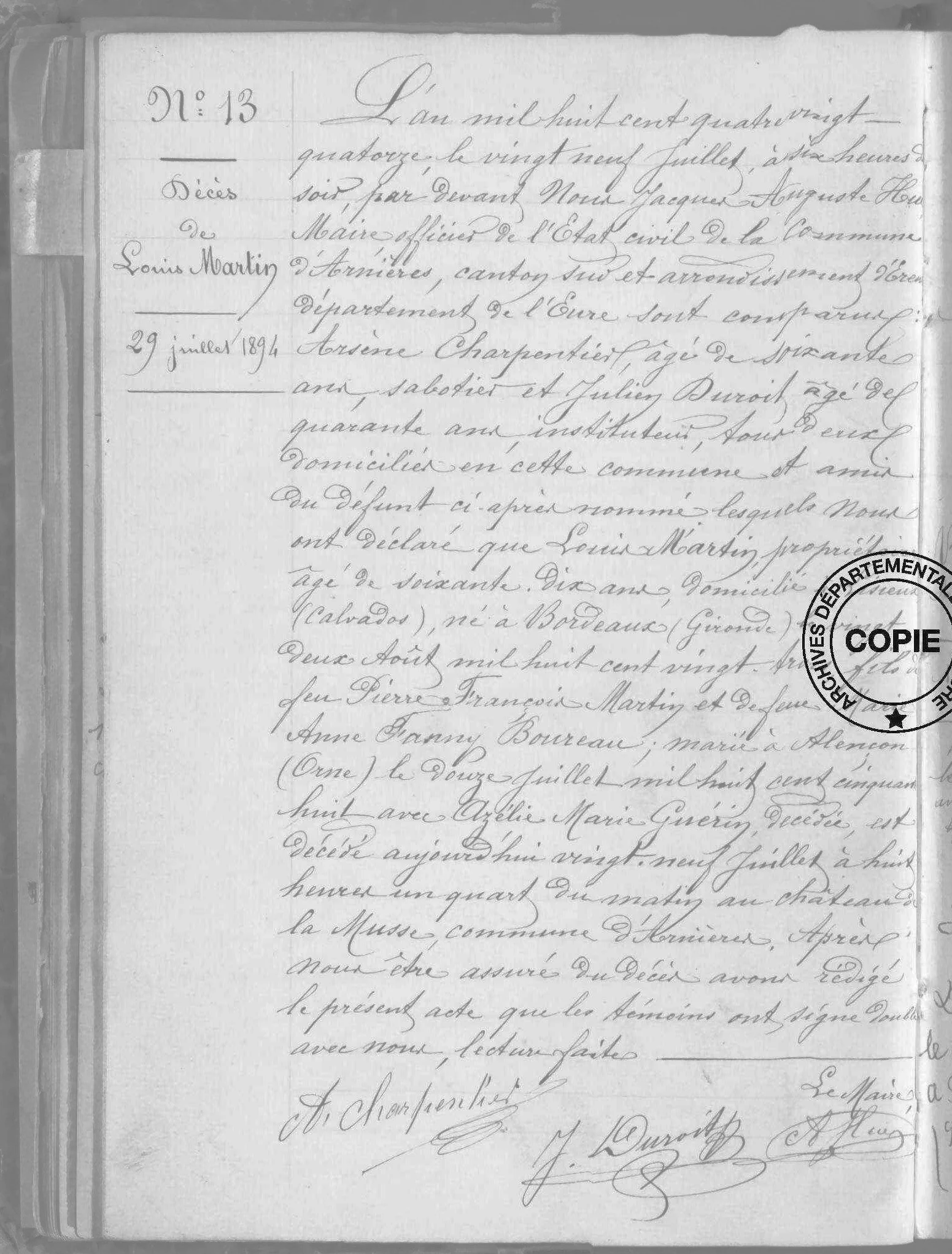
The original civil registration of Louis Martin’s death, recorded on July 29, 1894, in the civil register of Arnières‑sur‑Iton, Eure, less than two hours after his death at Château La Musse.
Source: Archives départementales de l’Eure, Commune d’Arnières‑sur‑Iton, Registre d’état civil (Décès), Année 1894, copie du registre pour les archives départementales.
English translation of the death record
Death Certificate No. 13: MARTIN Louis Joseph Aloys Stanislas
In the year eighteen hundred and ninety‑four, on the twenty‑ninth of July, at ten o’clock in the morning, before us, Jacques Hyacinthe Henry, mayor and civil registrar of the commune of Arnières, southern canton and district of Évreux, department of the Eure, appeared Arsène Charpentier, aged sixty, shoemaker, and Julien Duroit, aged forty, schoolteacher, both domiciled in this commune and friends of the deceased named below, who declared to us that Louis Martin, property owner, aged seventy, residing in Lisieux (Calvados), born in Bordeaux (Gironde) on August 2, 1823, son of the late Pierre‑François Martin and the late Anne‑Fanie Boureau, married to the deceased Azélie‑Marie Guérin, died today, the twenty‑ninth of July, at a quarter past eight in the morning at the Château de la Musse, commune of Arnières.
After we had assured ourselves of the reality of the death, we drew up the present record, which the witnesses signed with us after it had been read to them.
(Signatures: A. Charpentier, J. Duroit, J. H. Henry, Mayor.)
Footnotes
Property owner — The word “propriétaire” in nineteenth‑century French civil records usually indicates someone living on income from property, savings, or investments, rather than actively engaged in a trade. It fits Louis Martin’s status after he retired from his watchmaking business in Alençon and moved to Lisieux.
Anne‑Fanie Boureau — The mother’s given name appears in the register in a cursive form consistent with “Fanie.” This matches independent biographical sources identifying Louis’s mother as Anne‑Fanie Boureau, rather than “Anne Flavie,” which is sometimes seen in less precise transcriptions.
Informants — The two men who formally reported the death are described as “amis du défunt,” friends of the deceased. In French administrative law, such individuals are called “déclarants.” In English vital records practice, they are referred to as “informants.”
What the original French civil death record says
N° 13
Décès de Louis Martin
29 juillet 1894
L’an mil huit cent quatre‑vingt‑quatorze, le vingt‑neuf juillet, à dix heures du matin, par devant nous Jacques Hyacinthe Henry, maire, officier de l’état civil de la commune d’Arnières, canton sud et arrondissement d’Évreux, département de l’Eure, sont comparus Arsène Charpentier, âgé de soixante ans, sabotier, et Julien Duroit, âgé de quarante ans, instituteur, tous deux domiciliés en cette commune et amis du défunt ci‑après nommé, lesquels nous ont déclaré que Louis Martin, propriétaire, âgé de soixante‑dix ans, domicilié à Lisieux (Calvados), né à Bordeaux (Gironde) le deux août mil huit cent vingt‑trois, fils de feu Pierre‑François Martin et de feue Anne‑Fanie Boureau, marié à Azélie‑Marie Guérin, décédée, est décédé aujourd’hui, vingt‑neuf juillet, à huit heures un quart du matin, au château de la Musse, commune d’Arnières.
Après nous être assuré du décès, nous avons dressé le présent acte que les témoins ont signé avec nous, après lecture faite.
A. Charpentier
J. Duroit
J. H. Henry, maire
The timing
The document shows the remarkable efficiency of nineteenth‑century French civil registration. Louis died at 8:15 a.m. Less than two hours later, his friends Arsène Charpentier and Julien Duroit had appeared before Mayor Jacques Hyacinthe Henry in Arnières‑sur‑Iton, and the death had been officially entered into the civil register at 10:00 a.m.—a span of only one hour and forty‑five minutes.
Why does this document matter?
At first glance, this is a routine rural death entry. In fact, it preserves one of the last documentary traces of the Martin family patriarch. Less than two hours after Louis Martin’s death, the event had already been formally entered into the public record, reported by two local friends and certified by the mayor of Arnières‑sur‑Iton.
The signatures at the bottom of the page are those Arsène Charpentier and Julien Duroit placed there on the morning Louis died, alongside the signature of Mayor Jacques Hyacinthe Henry. In their quiet way, they bear witness to one of the most significant moments in the history of the Martin family.
Why was Louis Martin at Château La Musse when he died?
Since his release from the Bon Sauveur mental hospital in Caen on May 10, 1892, Léonie and Céline had been taking care of Louis in a small house at 7 rue Labbey, across the alley from the back entrance to the mansion of their uncle, Isidore Guérin, in Lisieux. In 1893, Léonie returned to the Visitation of Caen for her second stay there, so Céline was the only Martin daughter with Louis when he died.
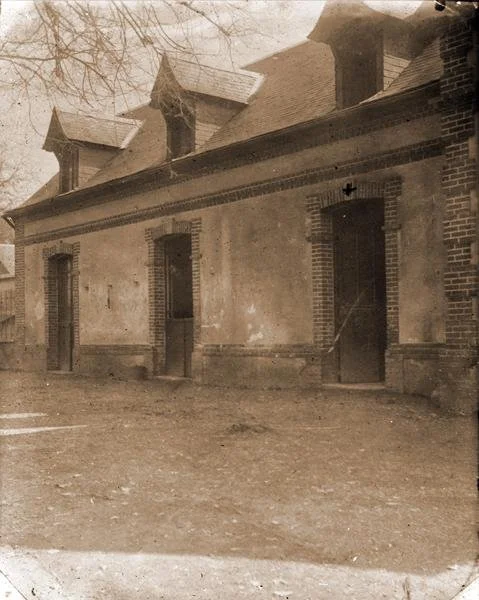
The pavilion at chateau la musse where louis martin died on july 29, 1894. courtesy of the web site of the archives of the carmel of lisieux.
With Mme Guérin’s cousins, the Maudelondes, the Guérins had inherited a country estate, Château La Musse, from her cousin M. Auguste David. It was located in the province of Eure, near Évreux, and fell on both sides of the boundary between two communes, Saint‑Sébastien‑de‑Morsent and Arnières‑sur‑Iton. The Guérins spent their summers at the château, which was surrounded by extensive parkland. Louis had joined them in 1893.
For more than two years, the comfortable rented house at 7 rue Labbey had served as a peaceful haven for the family after Louis returned to Lisieux. It had a long, narrow rear garden sloping down to a stream where Louis loved to sit.
As the summer of 1894 waned, Louis’s physical strength ebbed rapidly. He was partially paralyzed, had great difficulty speaking, and remained confined to a wheelchair
The Guérins sought to give the failing patriarch the ultimate gift: a return to the natural world he had loved so deeply throughout his life. On July 4, 1894, the family traveled from rue Labbey to the grand estate of La Musse. It was a journey intended to provide a tranquil sanctuary among the trees, but it would ultimately become the setting for Louis’s final days on earth.
At an uncertain date, they placed Louis in a small garden pavilion near the château. They were probably moved by several practical considerations: to simplify his care, to allow him to be as close as possible to the outdoors, and to spare him from having to be carried up the steep steps to the entrance of the château. It was then common for French families who lived in large, inaccessible estates to look after the sick in smaller buildings on their property.
Louis Martin’s final hours and his return to God
On Saturday, July 28, Louis had a new cardiac crisis. Father Bernardin‑Louis Chillart, parish priest of Saint‑Sébastien de Morsent, a friend of the Guérins, was hastily summoned and administered the last sacraments once more.
At five o’clock the next morning, since Louis’s eyes were closed and his breathing heavy, Louis’s servant awakened Céline. Céline remained alone with him, praying in a loud voice, until 8:15 a.m. When it became clear that his last moments were approaching, Isidore and Céline Guérin hastened into the room and witnessed his death.
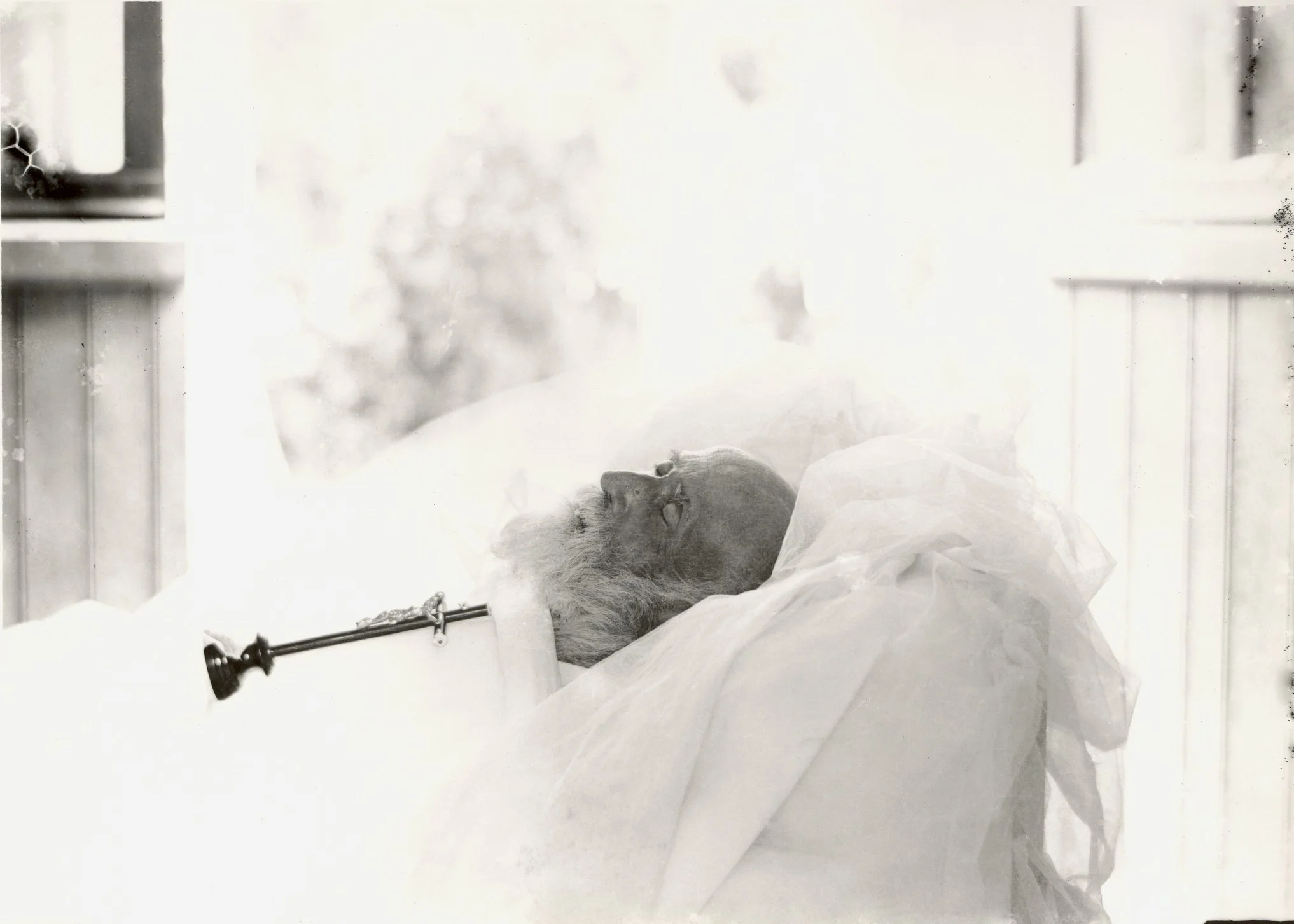
st. louis martin in death. courtesy of the web site of the archives of the carmel of lisieux.
See Céline’s letter of that day to her Carmelite sisters giving an account of Louis’s last hours.
Louis Martin’s funeral and burial
Louis’s body was returned to Lisieux. His funeral Mass, at the Cathedral of St. Pierre, attended by Céline, the Guérin family, and others, was celebrated on Thursday, August 2. His death card bore the image of the Holy Face of Tours. Thérèse and her sisters chose the Bible verses on the reverse side.
He was buried in the new Martin family plot in the municipal cemetery of Lisieux, farther up the hill where, sixty years later, Archbishop Joseph‑Marie Martin of Rouen would consecrate the basilica built in honor of his youngest daughter, St. Thérèse of Lisieux.
Footnote: Pope Pius XII—who, as Cardinal Eugenio Pacelli, had blessed the unfinished basilica during the National Eucharistic Congress of 1937—appointed Cardinal Maurice Feltin, Archbishop of Paris, as Papal Legate to preside at the consecration ceremonies in 1954. The Pope also sent a special radio message for the occasion.